
How Syria’s History Shapes Culture at Home, in the Markets, and at the Table
17-12-2025
Syria is not a country you can simply pass through. Its story begins with the world’s earliest civilizations and extends into the homes of Damascus and Aleppo, and their stone markets whose presence still lingers in memory. Syria’s history did not remain confined to books; over time, it became a way of life and a way of thinking that shaped Syrian culture as we see it today—clearly reflected in the home, the marketplace, and traditional Syrian cuisine.
This article offers clear and accessible information about Syria and its history, guiding you through a journey of Syria’s history and culture from a human, everyday perspective.

A Broad Look at Syria’s History: from the Kingdom of Ebla to Today
When we look back thousands of years, we find that Syria’s story is not a single line, but layered histories of cities, civilizations, and trade routes. These layers shaped the Syria we see today—in the form of its cities.
Where does Syria’s history begin—Ebla, or Palmyra?
When we open the pages of Syria’s history, we go back thousands of years to cities such as Ebla, Ugarit, and Palmyra. In Ebla, one of the earliest known kingdoms emerged, along with a vast archive of tablets that reveal a remarkably organized political and commercial life even by today’s standards.
On the coast, Ugarit rose as an important maritime city, and there the earliest known alphabet in history was discovered—enough on its own to place Syria at the heart of the story of writing and language.
And in the heart of the desert stood Palmyra, the city of trade and caravans, which later became a symbol of a powerful civilization led by Queen Zenobia. Its columns and palaces still tell part of that chapter.

From Roman and Byzantine cities to the features of today’s towns
With the Roman and Byzantine eras, the landscape changed, yet Syria remained a bridge between East and West. Organized cities spread, paved roads, theaters, and churches appeared, and the region became a major stop on trade routes.
Many of the ruins stretching from south to north today are direct remnants of those periods. Their influence is visible in architecture and in certain religious and social customs and rituals that continued in one way or another within Syrian culture.
Damascus was the capital of the Umayyad state
With the arrival of the Islamic era, an entirely new phase began in Syria’s history. Damascus became the first capital of the Umayyad Caliphate; from there, administration, sciences, and arts expanded. Islamic
architecture developed, mosques, markets, and palaces were built, and all of this was reflected in the shape of old neighborhoods and the texture of daily life up to the present. This period laid a deep foundation for the character of Syrian cities, especially Damascus.
Modern Syria and the diversity of cities and identities
Today, all these historical layers interact within modern Syria.
In Aleppo, you see a commercial and cultural spirit, and vast markets that feel like an open-air museum.
In Damascus, traditional Damascene houses and the calm tone of its people reflect the nature of an ancient city that is still alive.
The coast carries the breath of the sea and its culture, while the Jazira region preserves its agricultural and rural heritage and its connection to the land.
In this way, Syria’s history does not feel like a separate story—it is a background that accompanies every detail of life today.

Syrian Culture: a Way of Life Shaped Over Time
In Syrian culture, ancient and deeply rooted features still remain alive in everyday life, clearly reflected in customs, homes, and social relationships, as follows:
Hospitality is the first thing a visitor notices
A cup of coffee, a simple welcome, and a home that is always open. These small details reflect how close people are to one another. This simplicity is a core part of daily life in Syrian cities and villages.
Music: from Aleppine Qudud to Dabke
Qudud, muwashshahat, Damascene tarab, and dabke at celebrations—this blend reflects a rich artistic diversity shaped over centuries.
Old markets: the heart of the cities
Al-Hamidiyah Souq in Damascus and Souq al-Madina in Aleppo are clear examples of Syrians’ relationship with trade and everyday social life—crowded markets filled with crafts, perfumes, food, and stories exchanged between shopfronts.
Damascene houses: art for the inside, not the outside
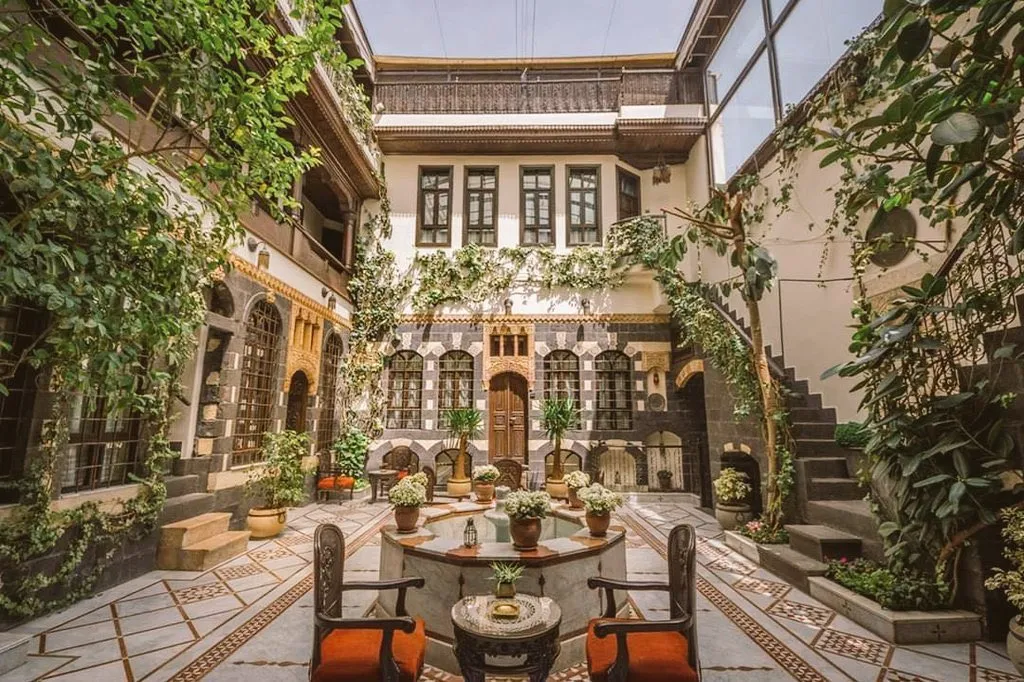
An inner courtyard, a small fountain, jasmine trees, and decorations that make the visitor feel in a different world. These houses were designed to gather the family and provide privacy and calm.

Traditional Syrian food: flavors that shape the identity of each city
Traditional Syrian cuisine does not express taste alone—it reflects the identity of each city, where flavors change just as environments and traditions differ from one region to another.
Aleppo: the cuisine of detail and precision
In Aleppo, cuisine feels like part of the city’s identity—dishes based on meat, bulgur, and nuts, with great attention to detail. Kibbeh in its many forms, stuffed vegetables, and various Eastern sweets make Aleppine cuisine one of the richest in the region.
Damascus: the table of home and family
In Damascus, the picture is simpler but no less deep. The Damascene table leans toward home and family: dishes like shakriyeh, stuffed zucchini, and grape leaves, alongside rice, grains, and everyday meals that reflect how Syrian culture treats food as part of family routine.
Damascene sweets—such as ma’amoul and certain types of ka’k and homemade pastries—are often tied to occasions and holidays.
The Syrian coast: food close to the sea and nature
Along the coast, proximity to the sea and nature appears in the dishes: grilled fish or simply cooked seafood like sayadiyeh, the use of fresh herbs, olives, and olive oil, and meals built on vegetables and grains—making coastal food lighter and closer to nature than the cuisine of the interior.
Eastern cities and the Jazira region: food rooted in land and generosity
In eastern cities such as Deir ez-Zor, Raqqa, Hasakah, and the Jazira region in general, people’s connection to the land shows clearly in daily food. Dishes rely on bulgur, meats, ghee, and taboon bread, with a strong presence of meals cooked in large quantities and served to family and guests together.
Foods like jareesh, different types of kibbeh, and rice cooked with meat or chicken reflect a mix of simplicity and generosity, showing how food becomes part of hospitality traditions and gathering around a single shared table.

Frequently Asked Questions about Syria’s History
In this section, we provide clear and concise answers to the most frequently asked questions about Syria’s history and civilization.
Why is Syria called the cradle of civilizations?
Because of its unique location as a crossroads between Asia, Europe, and Africa, Syria became a center for trade, migration, and the exchange of ideas. This led to the early rise of ancient cities and kingdoms such as Ebla, Ugarit, and Palmyra, leaving deep political, cultural, and linguistic influences—earning Syria the title “the cradle of civilizations.”
What is the oldest civilization in Syria?
One of the oldest civilizations associated with Syria is Ebla, located in the north of the country (Tell Mardikh near Idlib), dating back to the third millennium BCE. Ebla is known for its archive of cuneiform tablets, which reveal detailed information about administration, trade, and political relations, making it one of the earliest examples of organized civilization in the region.
Thinking about traveling to Syria?
Syria is not just a destination—it is a complete experience that begins with people before places, and with details before landmarks. In its old streets, markets, homes, and shared tables, you will discover that Syria’s history is still lived, not just told. This country carries layers of memory and identity that make visiting it unlike any other experience.
If you are looking for a journey with real meaning—not just a tourist program—and want an experience that brings together history, culture, and humanity, then this is your golden journey.
Contact us at:
+90 555 100 09 60 to receive the Syria Travel Guide 2026, plan your journey step by step, and discover the country from the inside, not just through images.