
Secrets of the Mesaharati : The Story of a “Drum” That Has Never Stopped for Centuries…
09-03-2025
The profession of the Ramadan drummer (Mesaharati) is considered a Ramadan icon and an inseparable part of Islamic heritage that refuses to fade. For centuries, the “suhoor call” has been closely associated with the enchanting nights of Ramadan across Arab and Muslim countries. How did this tradition begin? And what has enabled it to withstand modern technology? Discover the history of the Mesaharati and the diversity of his styles across cultures in a cultural journey that takes you to the heart of authentic traditions that give the holy month its unique and irreplaceable flavor.
From the early Islamic era to today: The journey of the “suhoor call”
The roots of waking people for suhoor date back to the time of the Prophet Muhammad ﷺ, when Bilal ibn Rabah would call the adhan before dawn, while Abd Allah ibn Umm Maktum would give the adhan at the actual time of imsak (the start of fasting). As Islamic cities expanded, this alert developed from an adhan heard from the mosque into a call that roamed through the streets.
Some historical accounts mention that Anbasa ibn Ishaq in Egypt was among the first to introduce organized suhoor calls in 228 AH (843 CE), walking from Fustat to Mosque of Amr ibn al-As to wake people.
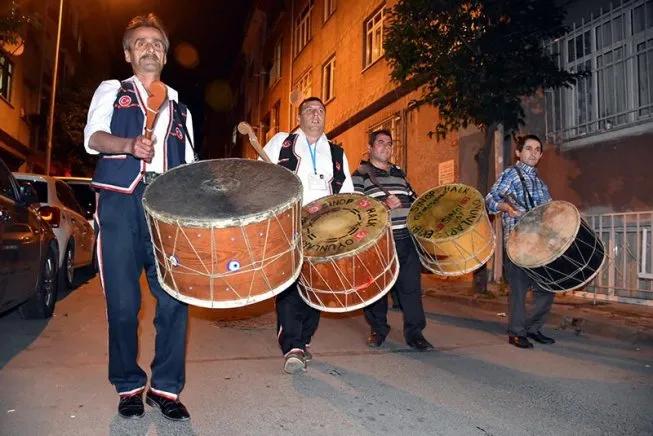
During the Ottoman era, the Mesaharati took on a distinctly festive character and became known as “Ramazan Davulcusu.” He carried a large drum (davul) and walked through neighborhoods to wake fasting people before dawn. His role was not limited to drumming; he also recited supplications and poetic verses, making his presence a distinctive spiritual and social feature of Ramadan in Turkey.

“Ramazan Davulcusu” – How do Turks preserve the rhythm of the Ramadan drummer in the heart of Istanbul?
Despite alarms and modern technology, the sound of the drum still precedes the dawn adhan in some neighborhoods of Istanbul. The “Ramazan Davulcusu” does not merely perform a functional task; he preserves an old Ramadan ritual that gives the night its distinctive rhythm. Dressed in traditional Ottoman attire, carrying his large drum, he walks the streets with steady steps—as if the city grants him a small space to turn time backward.
More than just drumming
In some neighborhoods, residents know him by name, and he sometimes calls them by their names. His presence strengthens bonds between neighbors and gives children a nightly moment to anticipate. Here, the mesaharati transforms from a “human alarm” into a social symbol reflecting the spirit and cohesion of the community.
Eidiya… a closing gesture of appreciation
At the end of Ramadan, families offer him an “Eidiya” as a token of appreciation for his commitment throughout the month. In some areas, he visits after Eid to greet families and collect his reward in simple yet warm gatherings—affirming that his relationship with residents is not fleeting.
An organized heritage, not left to chance
Today, the presence of the mesaharati is no longer random. Some municipalities grant official permits and regulate their working areas. Training initiatives have also been organized to preserve traditional rhythms, such as the programs held in Edirne, ensuring that this folk art is passed on to future generations.
In this way, the “Ramazan Davulcusu” remains present in the heart of Istanbul—not because he is necessary for waking people up, but because he is necessary for memory.

Famous mesaharati phrases engraved in collective memory
The mesaharati’s phrases were never random. They were short, rhythmic, and easy to remember. Among the most famous:
- “O sleeper, worship the Everlasting One.”
- “Wake up, fasting one… declare God’s oneness.”
- “Rise for your suhoor… Ramadan has come to visit you.”
- “Suhoor, O servants of God… remember God.”
- “Prayer is better than sleep… rise for your suhoor.”
In some neighborhoods, he would personalize the call by mentioning residents’ names, for example:
- “Abu Muhammad… it’s your suhoor, O fasting one.”
In Turkey, the “Ramazan Davulcusu” accompanies his drumming with short folk verses blending supplication and reminders of suhoor’s blessings—turning the words into a daily ritual that repeats, yet never loses its impact on memory.
Was the profession limited to men? Stories of female mesaharatis through the ages
Historically, the role of the mesaharati was not exclusively limited to men, although the majority were male due to the nature of walking through streets and alleys at night. In some societies, women took on the role of “female mesaharati,” particularly within closed neighborhoods or rural areas where the social environment allowed it.
In small towns and villages, some women participated in waking neighbors or accompanied family members in carrying out the task, especially when the goal was to preserve a long-standing family tradition. Over time, with increased safety and organization, women’s participation became more visible—whether on a voluntary basis or as part of Ramadan Activities in Istanbul.
Today, the profession is no longer associated with a specific gender as much as it is linked to preserving Ramadan heritage itself.
Between the drum, the nafir, and the baz: The diversity of the “suhoor icon’s” tools around the world
Below is an organized presentation placing the mesaharati’s tools side by side to facilitate comparison and better understand their differences in sound, usage, and geographical spread.
| Tool | Usage | Main Feature |
|---|---|---|
| Drum (Davul) | Rhythmic beating to wake people | Loud sound that carries over long distances |
| Nafir (horn) | Blown sound to alert residents | Sharp, attention-grabbing tone before dawn |
| Baz / Folk Mizmar | Short melodic playing alongside the call | Combines rhythm and melody |
| Daf | Light rhythm accompanying chants | Soft sound with a spiritual atmosphere |
To read more articles about Ramadan in Turkey, you can visit the following article: Ramadan Cannon

The “Ramadan Nights” Experience – Why are tourists drawn to the sound of the mesaharati in old cities?
The sound of the mesaharati echoing through narrow alleys and historic houses carries a unique charm that makes Ramadan nights unlike any other experience. For tourists, this sound is not merely drumbeats or a call for suhoor; it is a window into the life of the old city and its social spirit. It blends folk rhythm, gentle supplication, and traditional chants passed down through generations—giving listeners a sense of intimacy and immersion in a living culture that has endured despite modernity.
In neighborhoods such as Fatih and Uskudar—often explored through historical tours of Istanbul—the mesaharati walks through narrow streets, his voice mingling with the scent of fresh bread, glowing window lights, and children’s laughter. This full sensory experience makes visitors feel part of Ramadan rituals in Turkey, far from modern hotels and restaurants, transforming them into witnesses of a living cultural heritage.
In short, the mesaharati’s appeal to tourists lies in the blend of authenticity, live rhythm, and social interaction—making the pre-dawn drumbeat an unforgettable experience.

Frequently Asked Questions
Here are the key points that answer common questions about the mesaharati and his role during Ramadan:
Does the mesaharati receive payment for his work?
In most cases, the mesaharati does not receive an official salary throughout the month. He relies on the symbolic “Eidiya” offered by residents as appreciation for his efforts. In some cities, municipalities may organize official permits or provide small rewards to preserve the tradition.
Why does the mesaharati disappear in big cities and appear in villages?
This is relatively true due to fast-paced urban life, alarm clocks, and high-rise buildings. However, he has not completely disappeared from cities; his presence has only declined in certain neighborhoods.
What is the difference between the mesaharati in Turkey and in Arab countries?
The difference lies more in names and tools than in essence. In Turkey, he is known as “Ramazan Davulcusu” and typically uses a drum, while in some Arab countries tools such as the nafir (horn) or daf are used. The essence remains the same: waking people for suhoor.
What is the story of the “baz” carried by the mesaharati?
The baz, or folk mizmar, is a short musical instrument used in some rural areas to add a light melody to the suhoor call, giving the ritual a festive character and making the sound more appealing to both children and residents.
The Mesaharati: A tradition that restores Ramadan’s voice every year
Across the centuries, the mesaharati has remained an integral part of Ramadan’s atmosphere in Turkey, carrying the scent of the past and the charm of old customs. Despite many changes in modern life, his voice still echoes in certain neighborhoods, adding a warm touch that revives memories of authentic Ramadan nights.
Do not let Ramadan pass without experiencing the magic of its nights in Istanbul or Fes. Contact us on WhatsApp at +90 555 100 09 60 and book your trip now with FGI Travel to live the authentic heritage atmosphere behind the rhythms of the mesaharati.